

SunPeek FAQ#
What is “SunPeek”?
SunPeek is an open-source software tool that provides a transparent, high-quality implementation of the ISO 24194 Power Check. The software offers functionalities for plant configuration, data upload and inspection, automated data quality checks, calculation of performance metrics, and generation of reports. SunPeek also incorporates a database of Solar Keymark certified collectors, facilitating easy access to collector parameters required for Power Check.
What is ISO 24194?
ISO 24194 (Solar energy — Collector fields — Check of performance) is a technical standard that defines multiple methods for verifying the performance of solar thermal collector fields. SunPeek currently provides an implementation of the ISO 24194 Power Check. An updated version of ISO 24194 is expected in 2026.
What can SunPeek be used for?
SunPeek can be applied to solar thermal plants in operation if measurement data is available. More specifically, the following use cases are possible using Power Check:

Does my collector field work as expected?
SunPeek allows you to estimate the power of solar thermal collector fields. The estimated power in certain valid intervals (criteria defined in ISO 24194) can be compared with measured power, to assess if the plant works as expected. For example, this might be used for quality assurance or even performance guarantees.

How does collector field performance change over time?
A similar procedure can be used to monitor the collector performance over time. Again, SunPeek computes the estimated power output of the collectors in certain valid intervals. By continuously observing the ratio of measured versus estimated power over time, one can identify potential anomalies or performance degradation. For example, this can be used to check the effect of collector soiling / cleaning on the collector performance (see figure in the example below).
Example - Assessment
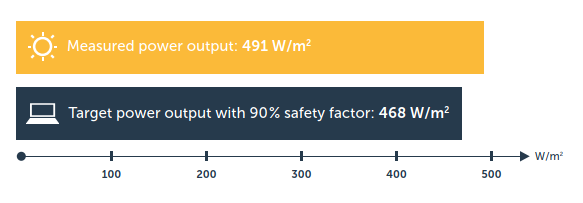
This shows an example result of a collector assessment. The ISO 24194 Power Check is fulfilled if the measured power output during valid operating intervals is greater than the target power output including a safety margin. A check requires at least 20 hours with valid operating conditions (We will cover what is considered valid in the next section).
In the depicted case, Power Check according to ISO 24194 is fulfilled.
Example - Monitoring
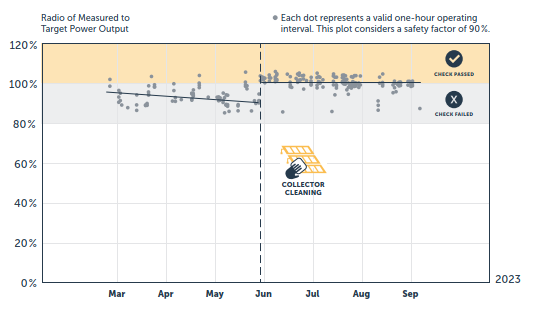
This shows an example of a collector cleaning at a plant with severe dust pollution. The plot depicts the ratio of measured versus estimated power for all valid intervals. (We will cover what is considered valid in the next section). Note that the dots are originally close to 100% but then decrease - indicating a collector degradation. After a cleaning event, the collector performance is close to 100% again.
What are the benefits of using SunPeek?
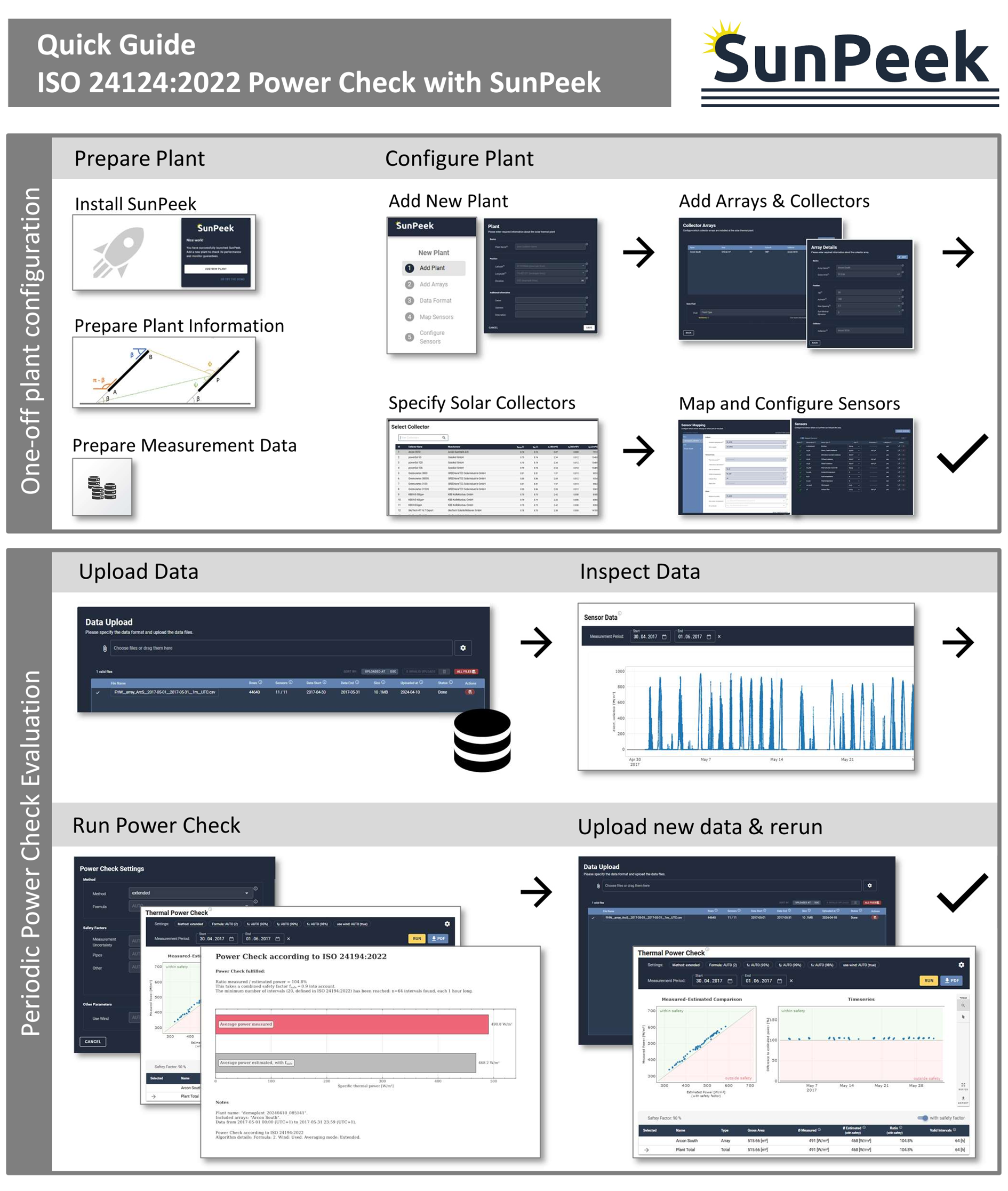
With SunPeek, you don’t have to implement the ISO 24194 Power Check yourself. Instead, SunPeek takes care of the complicated parts and guides you through the procedure with its user interface. All you need to do is configure your plant and collectors, and upload measurement data.
Aiming to make quality assurance more transparent and accessible for everyone, we tried our best to make this process as easy and fun as possible. The following figure provides an overview on how Power Check can be applied using SunPeek.
How can I contribute to the development of SunPeek?
We encourage community-based development for future revisions of SunPeek. Users, researchers, and developers are invited to contribute in various ways: by sharing real-world use cases, providing open datasets of plant operation, engaging in discussions and proposing improvements, contributing code to SunPeek, or developing educational materials. For details, see the SunPeek Contribution Guide.