

Collectors#
This page explains how solar collectors work in SunPeek, including the available collector types, test methods, incidence angle modifiers (IAM), and how to add custom collectors.
Overview#
Solar collectors are characterized by their thermal performance parameters, which are determined through standardized testing according to ISO 9806. Collector performance data can mainly be found from the Solar Keymark Database, the official European certification database, containing detailed collector data sheets. SunPeek uses these performance parameters to model collector behavior and calculate expected performance.
SunPeek also offers the option to define custom collectors, either via the WebUI or programmatically using Python. See Adding Custom Collectors for details.
Collector Parameters#
The following table describes the key collector parameters used in SunPeek, as defined in ISO 9806:
Parameter |
Description |
Unit |
|---|---|---|
\(a_1\) |
First order heat loss coefficient at \(\vartheta_m - \vartheta_a = 0\) K |
W/(m²·K) |
\(a_2\) |
Second order heat loss coefficient (temperature dependence of heat loss) |
W/(m²·K²) |
\(a_5\) |
Effective thermal capacity |
kJ/(m²·K) |
\(a_8\) |
Fourth order heat loss coefficient (radiative losses dependence) |
W/(m²·K⁴) |
\(\eta_{0,b}\) |
Peak collector efficiency based on beam irradiance \(G_b\) (at \(\vartheta_m - \vartheta_a = 0\) K) |
– |
\(\eta_{0,hem}\) |
Peak collector efficiency based on hemispherical irradiance \(G_{hem}\) (at \(\vartheta_m - \vartheta_a = 0\) K) |
– |
\(K_b\) |
Incidence angle modifier (IAM) for direct/beam solar irradiance |
– |
\(K_d\) |
Incidence angle modifier for diffuse solar radiation |
– |
\(K_{hem}\) |
Incidence angle modifier for hemispherical solar radiation |
– |
The following figure shows where to find these parameters on a Solar Keymark certificate:
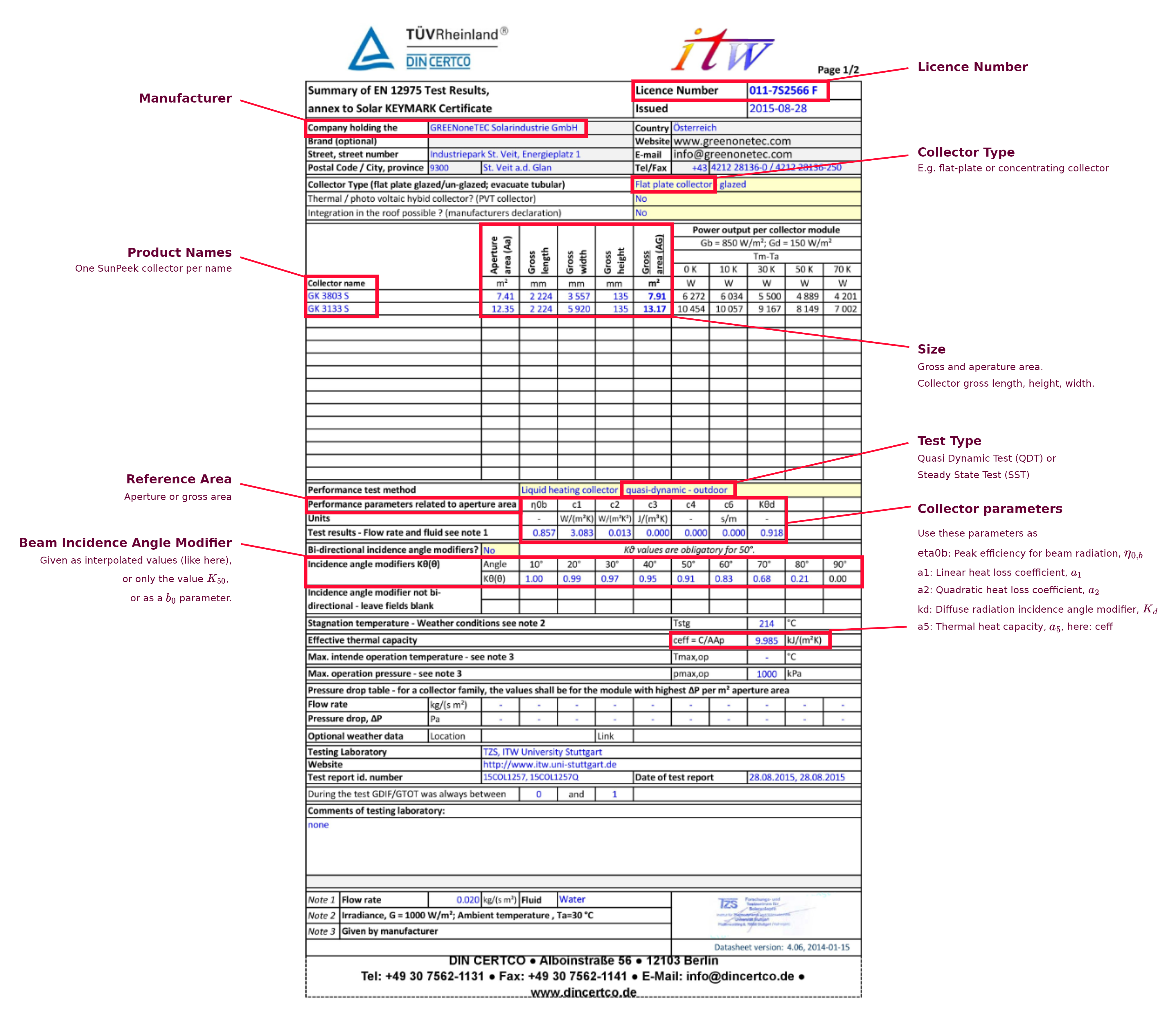
Annotated Solar Keymark certificate showing where to find collector parameters for QDT-tested collectors.#
Here is an example of how to programmatically create a QDT-tested collector in SunPeek. This is taken from the Python example script_demo_custom.py.
from sunpeek.components import CollectorQDT, CollectorTypes, IAM_Interpolated
from sunpeek.common.unit_uncertainty import Q

collector = CollectorQDT(
    name='my collector',
    manufacturer_name='xyz',
    product_name='abc',
    collector_type=CollectorTypes.flat_plate,
    test_reference_area='gross',
    area_gr=Q(12, 'm**2'),
    gross_length=Q(2400, 'mm'),
    gross_width=Q(5000, 'mm'),
    gross_height=Q(150, 'mm'),
    # Performance parameters from Solar Keymark certificate
    eta0b=Q(0.75, ''),
    a1=Q(2.3, 'W m**-2 K**-1'),
    a2=Q(0.01, 'W m**-2 K**-2'),
    a5=Q(7.5, 'kJ m**-2 K**-1'),
    kd=Q(0.94, ''),
    iam_method=IAM_Interpolated(
        aoi_reference=Q([10, 20, 30, 40, 50, 60, 70, 80, 90], 'deg'),
        iam_reference=Q([1, 0.99, 0.97, 0.94, 0.9, 0.82, 0.65, 0.32, 0]),
    ),
)
Test Methods#
SunPeek supports collectors tested with two methods defined in ISO 9806, namely QDT and SST.
See also
API documentation QDT collectors:
sunpeek.components.CollectorQDTAPI documentation SST collectors:
sunpeek.components.CollectorSST
Quasi-Dynamic Test (QDT)#
The QDT method is the modern standard and recommended approach. It provides:
\(\eta_{0,b}\): Beam optical efficiency at normal incidence
\(K_d\): Characterization of diffuse radiation response
Steady-State Test (SST)#
SST collectors are still supported for backward compatibility. The SST method is the older approach, providing:
\(\eta_{0,hem}\): Hemispherical optical efficiency
\(c_{eff}\): Effective thermal capacity
Parameter Conversion (SST ↔ QDT)#
Depending on the test method used and the ISO 24194 formula chosen for Power Check, conversion between SST and QDT parameters may be necessary. Based on ISO 9806 and the Guide to ISO 9806, SunPeek handles the conversion like this:

Parameter conversion between SST (steady-state) and QDT (quasi-dynamic) tests. Source: Section A.3, Guide to ISO 24194:2022 Power Check.#
Incidence Angle Modifier (IAM)#
The IAM describes how collector efficiency changes as the sun moves away from the perpendicular (normal) direction. At normal incidence (sun directly facing the collector), IAM = 1. As the angle increases, IAM decreases due to increased reflection and absorption losses.
SunPeek supports several IAM calculation methods:
ASHRAE Model: A simple analytical model using one parameter (
b0), typically between 0.05 and 0.2.K50 Model: A variant of the ASHRAE model where only the IAM value at 50° incidence angle (K50) is known. The model derives the
b0parameter fromK50.Ambrosetti Model: An alternative analytical model using an exponent parameter (
kappa).Interpolated IAM: For collectors with measured IAM values at specific angles, SunPeek interpolates between the reference points. This is the most accurate method when manufacturer data is available. For flat plate collectors, provide one set of reference values. For concentrating collectors with different longitudinal and transversal behavior, provide a 2D array with separate values for each direction.
See also
See the API documentation for sunpeek.components.iam_methods for detailed information
and usage examples.
Available Collectors#
SunPeek currently includes a curated set of pre-defined collectors from various manufacturers. These collectors can be selected in the WebUI during plant configuration (see Collector Selection) or accessed programmatically via the Python API.
Note
Ongoing Development: The collector database is being refactored into a separate package sunpeek-collectors to integrate all collectors from the Solar Keymark database. This will significantly expand the available collectors.
Name |
Manufacturer |
Type |
Test |
|---|---|---|---|
Arcon 3510 |
Arcon-Sunmark A/S |
Flat plate |
QDT |
powerSol 55/120/136 |
Gasokol GmbH |
Flat plate |
QDT |
GK 3803/3133 (+ S variants) |
GREENoneTEC |
Flat plate |
QDT |
K5 Giga+ series |
KBB Kollektorbau |
Flat plate |
QDT |
HT series |
oekoTech |
Flat plate |
QDT |
DIS 150 |
ensol |
Flat plate |
QDT |
FPC1500C |
Sunrain |
Flat plate |
QDT |
MT-Power v4 |
TVP Solar |
Flat plate (vacuum) |
QDT |
T160 |
Absolicon |
Concentrating |
QDT |
MEGA 26/78 |
Ako Tec |
Concentrating |
QDT |
SF500-15 (+ DG) |
Savo Solar |
Flat plate |
SST |
CCS+ |
CONA |
Flat plate |
SST |
Adding Custom Collectors#
Via the WebUI#
The easiest way to add a custom collector is through the web interface during plant configuration. See the arrays tutorial for step-by-step instructions on collector selection and custom collector entry.
Via Python#
You can also create collectors programmatically using the Python API. Use sunpeek.components.CollectorQDT
for quasi-dynamic tested collectors or sunpeek.components.CollectorSST for steady-state tested collectors.
For a complete working example, see the demo script script_demo_custom.py, which demonstrates how to create a custom collector with all required parameters and an IAM method, and how to use the collector with a collector array to run Power Check.
See also
sunpeek.components.Collector- Base collector class with all available parameterssunpeek.components.CollectorQDT- Factory for QDT collectorssunpeek.components.CollectorSST- Factory for SST collectorssunpeek.components.iam_methods- IAM calculation methods